

Author Darlene J. Conard
“Your journey has molded for the greater good. It was exactly what it needed to be. Don’t think you’ve lost time. It took each and every situation you have encounter to bring you to the now, and now is right on time.”
-Asha Tyson-
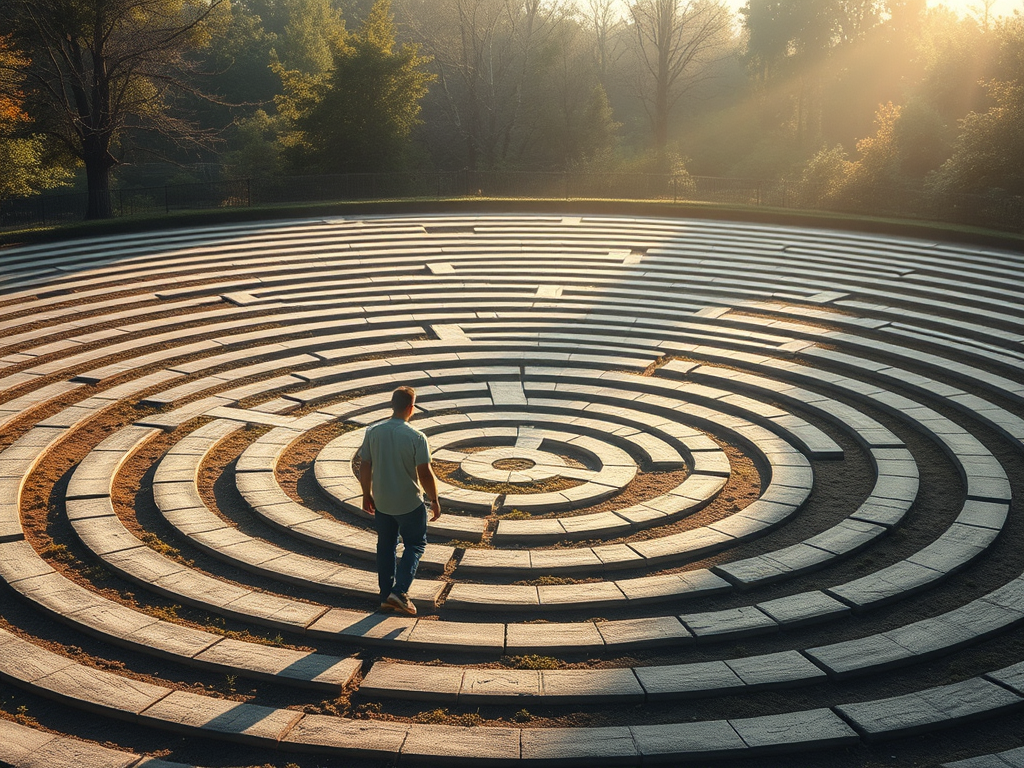
During the Middle Ages, a significant movement called the Crusades motivated many Christians to embark on pilgrimages to the Holy City of Jerusalem. A system known as a labyrinth was developed to support these journeys and ensure the safety of pilgrims traveling through potentially dangerous territories. This intricate network of pathways served not only as a physical guide but also as a symbolic representation of the spiritual journey and devotion of the pilgrims.
A labyrinth differs from a maze because it has no blind alleys or dead ends. It is unicursal, meaning there is only one path to the center and back out, which twists and turns multiple times. Once at the center, there is only one exit.
Walking a labyrinth does not have a specific time requirement, as each labyrinth is distinct in its design and layout. The duration can vary greatly, with some labyrinths taking as little as 5 minutes to complete, while others may require a significantly longer time commitment.
Labyrinths come in various patterns, ranging from simple to intricate designs, and their sizes can differ significantly. Navigating a maze involves simply following the established path, eliminating any need to solve a puzzle. This approach allows your mind to concentrate more fully on meditation or prayer.
The labyrinth was thoughtfully designed to provide a secret and secure passage through the diverse landscapes of Palestine, allowing pilgrims to navigate safely away from the threats and uncertainties accompanying their journeys. Many Christians made a heartfelt commitment, often vowing to visit Jerusalem at some point to express their faith and dedication to their beliefs. The labyrinth enabled these pilgrims to fulfill their vows with a degree of safety, allowing them to embark on their sacred quests with the hope of reaching the revered city that held immense spiritual significance. Thus, the labyrinth became a physical pathway and a symbol of faith, resilience, and the deep yearning to connect with the divine.
The ancient Romans were known for their intricate designs, including creating labyrinth patterns that adorned their structures’ floors and walls. These elaborate geometric patterns, often composed of winding paths and turns, served as decorative elements and art that invited observation. Walking along the twisting routes of a labyrinth is believed to promote a sense of tranquility and mental clarity, allowing individuals to reflect inwardly and find comfort from the chaos of daily life. This practice of walking the labyrinth can act as a meditative journey, encouraging a peaceful state of mind while offering a profound connection to the symbolic significance of the maze.
Our path is uniquely crafted through Jesus. Through His sacred presence, we transcend the idea of a mere route; it unfolds with intricate layers of safety, enlightenment, and purpose. As we walk this path, we find solace from the world’s clamor, a refuge where chaos fades and peacefulness reigns. Along the way, we are bestowed with profound wisdom that enhances our understanding of ourselves and God’s will, shaping our lives and steering us toward a more meaningful and fulfilling existence.
… “the path of the just is as the shining light, that shineth more and more unto the perfect day.” Proverbs 4:18 KJV
Feel free to forward it to anyone you wish. My mission is to encourage everyone to follow our Lord Jesus Christ with all their heart, soul, mind, and strength. ©Darlene J. Conard Vision Ministries 2024. This may not be republished or used without the author’s written consent. The photograph is AI-generated. Darlene J. Conard is also affiliated with Glory Carrier Ministries.
 WRITING GOD'S VISION----AUTHOR DARLENE JUANITA CONARD